


Understanding Descriptive Text in Writing
Descriptive text is one of the most engaging forms of writing. It gives readers something to visualize, something to sense, and sometimes even something to feel on an emotional level. Whether we find it in novels, travel essays, feature articles, or everyday storytelling, descriptive writing is what makes scenes vivid and memorable.
But what actually makes writing descriptive?
And how do great writers make ordinary moments feel alive?
This article explores what descriptive text is, why it matters, the language features behind it, and how it appears in literature—complete with short examples.
What Is Descriptive Text?
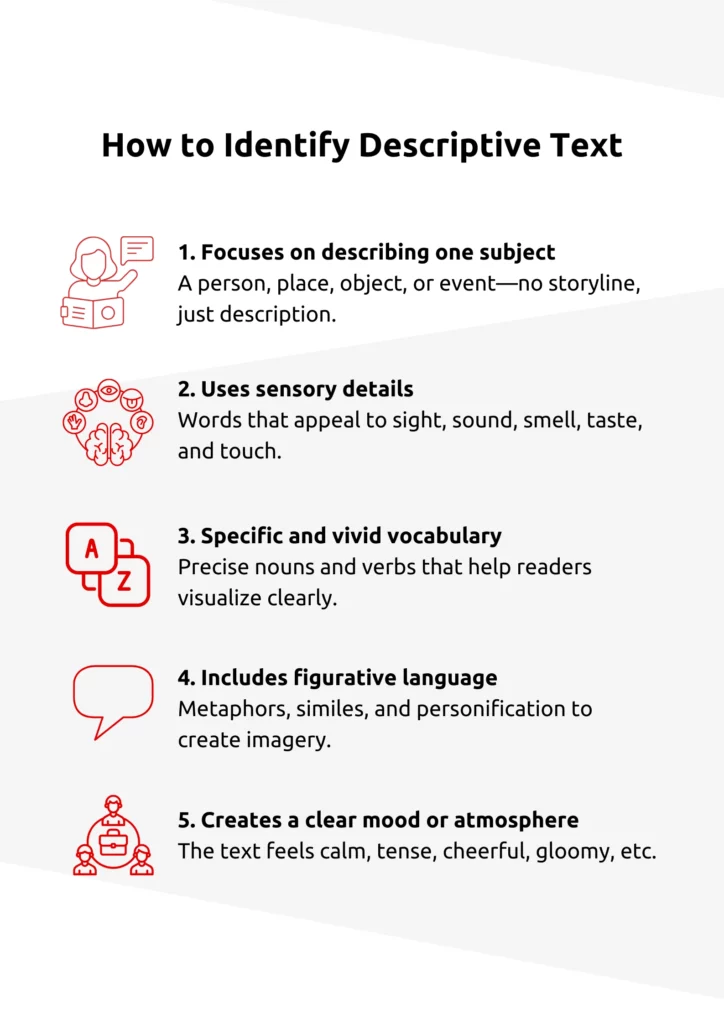
Descriptive text is writing that focuses on describing a person, place, object, or event in a way that allows readers to imagine it clearly. Unlike informative writing, which prioritizes accuracy and facts, descriptive writing prioritizes experience.
It answers questions like:
- What does it look like?
- What does it sound like?
- What does it smell or feel like?
- What mood does it create?
Good descriptive writing doesn’t rely on flowery language. Instead, it chooses specific, meaningful, and sensory-rich details.
Purpose of Descriptive Text
Writers use descriptive text to:
- help readers form clear mental images
- create mood or emotion
- highlight important characteristics
- slow down the narrative for emphasis
- bring scenes and storytelling to life
This makes descriptive writing valuable across fiction, journalism, marketing, and personal writing.
Key Language Features of Descriptive Text
1. Sensory Details
Descriptions that involve sight, sound, smell, taste, and touch create immersive writing.
2. Specific Vocabulary
Precise nouns and verbs are more effective than long explanations.
Example: the driftwood chair vs. the old wooden chair.
3. Figurative Language
Metaphors, similes, and personification enhance imagery.
4. Adjectives and Adverbs (used intentionally)
Effective descriptive writing avoids overcrowding.
5. Spatial or Logical Order
Descriptions often follow a path—top to bottom, left to right, near to far, or outside to inside.
Examples From Literature
Charles Dickens — Great Expectations
“The marshes were just a long black horizontal line… the sky was a row of angry red lines and dense black lines intermixed.”
Why it works:
Sharp color imagery creates a bleak, unsettling setting.
Virginia Woolf — To the Lighthouse
“The window showed an expanse of tranquil blue, against which the lighthouse lifted its white pillar.”
Why it works:
Simple, calm vocabulary shapes a peaceful mood.
F. Scott Fitzgerald — The Great Gatsby
“The lights grow brighter as the earth lurches away from the sun, and now the orchestra is playing yellow cocktail music…”
Why it works:
Synesthetic imagery (“yellow music”) conveys energy and glamour.
Structure of Descriptive Text
Most descriptive paragraphs follow two main parts:
1. Identification / Opening
Introducing the person, place, or thing.
Example: “The old library stood quietly at the edge of town…”
2. Description
Detailed sensory and figurative elaboration.
Example: “…its stone walls wrapped in ivy, windows glowing faintly under the afternoon sun.”
The structure is flexible, but this pattern is common in both academic and creative writing.

Sample Descriptive Paragraph (Original Example)
The alley smelled faintly of roasted corn and damp pavement. Strings of yellow bulbs hung overhead, swaying gently in the evening breeze. Vendors lined the narrow walkway—one stirring a bubbling pot of spices, another slicing fruit with soft rhythmic taps. Children darted between the stalls, their laughter blending with the crackle of oil and the distant hum of radio music drifting from an open window.
Notice how sensory cues (smell, sight, sound), movement, and specific details help readers picture the scene.
When Descriptive Text Is Useful
Descriptive writing strengthens:
- stories and novels
- travel writing
- character and setting introductions
- product descriptions
- personal narratives
- feature journalism
Any genre that hopes to connect emotionally with readers benefits from good descriptive detail.
Tips to Improve Descriptive Writing
- Show, don’t tell.
Replace “She was nervous” with “Her fingers wouldn’t stay still.” - Be specific.
Details matter more than fancy adjectives. - Use strong nouns and verbs.
They create imagery naturally. - Avoid overloading the sentences.
Too many descriptors weaken clarity. - Engage more than one sense.
- Consider the mood.
Ask: What should the reader feel here?
Summary
Descriptive text is a powerful tool that transforms simple information into vivid experience. By using sensory details, clear imagery, and intentional language choices, writers can create scenes that readers not only understand, but feel. Whether in literature or everyday writing, description helps build atmosphere, deepen emotion, and make stories memorable.
With a few thoughtful techniques—specific vocabulary, sensory cues, and a strong sense of mood—any writer can bring their ideas to life in a way that stays with the reader long after the last sentence.
—
At IELC, we teach English the right way
Our goal is to get you speaking in English with fluency and confidence as fast as possible. We want to give you the skills you need to fulfil your potential!
Our experienced teachers will guide you along every step of the learning process to ensure that you are not wasting your time, money, and energy on useless language exercises & wrong methods.
Our courses
With our modern campus and technology, we are equipped to provide the best possible courses for children, teens, and adults, including:
Online and on campus IELTS courses
Online and on campus TOEFL PBT courses
Online and on campus TOEFL iBT courses
We offer our classes in group classes or private classes.
No matter what your goals are, our team will help you achieve these goals by providing you with Indonesia’s best English courses!
Talk to our team today to get your FREE consultation and take your first step towards success.
Sincerely,

IELC Academic Director
Read More Articles

From B1 to B2: What the Jump Actually Feels Like
You’re three episodes into a series before you notice you stopped reading the subtitles. Or you’re texting someone in English and realize you never once opened Google Translate. Nothing dramatic…

How Asia Celebrates Vesak
Vesak marks three moments in the life of Siddhartha Gautama — his birth, his enlightenment, and his passing. One occasion, observed across the continent. But spend time with any of…
How to Track Your Child’s English Progress at Home
Tracking a child’s language progress at home is confusing. Last week they were singing along to their favorite cartoon. This week, asked a simple “how are you?” — nothing. It’s…

6 Strategies for Writing Emails that People Actually Read
Most mornings start the same way — an inbox with more unread messages than anyone wants to count, and a trigger finger ready to delete. Senders rarely know their email…
8 Tips to Make Your Lessons ADHD-Friendly
Real strategies for teachers who want every student — yes, every single one — to thrive. Every classroom has that one puzzle that’s harder to solve — and ADHD is…

TOEFL iBT vs. TOEFL ITP (PBT)
What’s the Difference and Which One Do You Need? So you’ve decided to take the TOEFL — great first step! But then you start researching and suddenly there are two…