



How to Track Your Child’s English Progress at Home
Tracking a child’s language progress at home is confusing. Last week they were singing along to their favorite cartoon. This week, asked a simple “how are you?” — nothing. It’s hard to know whether that’s a setback or just how the process works.
Most parents don’t realize that real signs of language growth rarely show up in tests or drills. They show up in the gaps — at dinner, during solo play, halfway through a TV show. Once you know what to look for, the picture becomes a lot clearer than it feels.
Not sure if your child’s English is improving? Here are 5 simple ways to track their progress at home — no tests, no flashcards needed.
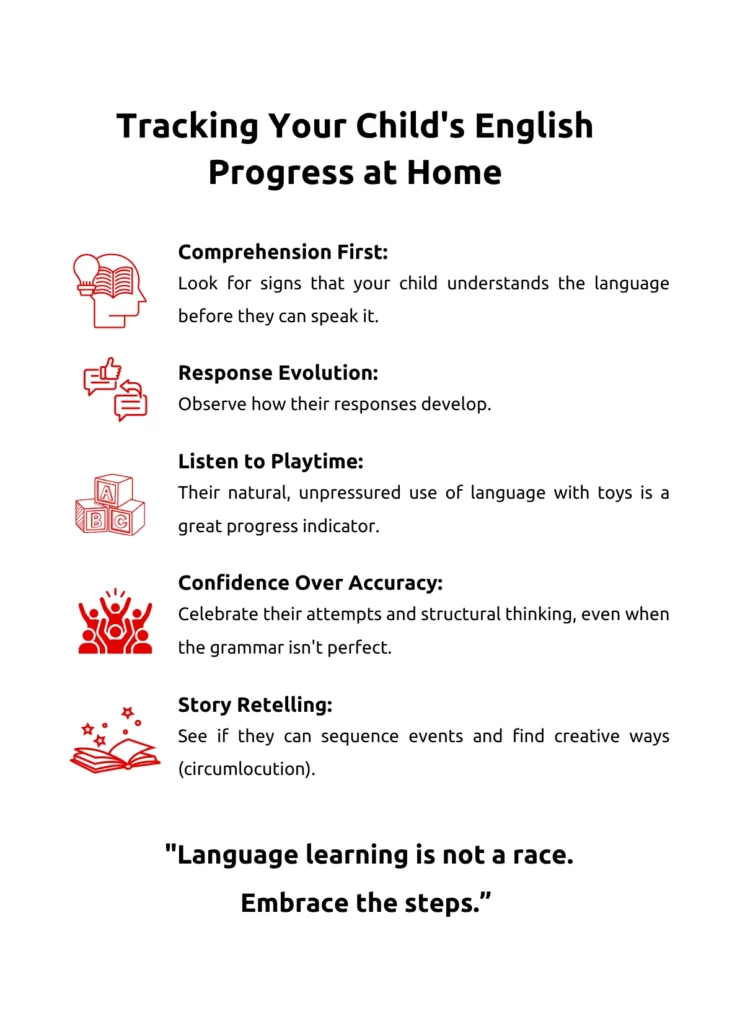
1. Understanding Comes Before Speaking
A quiet child isn’t necessarily a child who isn’t progressing.
Receptive language — the ability to understand — always develops ahead of expressive language — the ability to speak. So before worrying that your child isn’t forming full English sentences yet, check whether they’re comprehending first.
Try a few simple things:
- Say “Please put your shoes by the door” without pointing — do they do it?
- When they watch an English cartoon, do they laugh at the right moments? Does their expression shift with the mood of the story?
If yes, their brain is actively processing the language — even without a single word coming out. That counts.
2. Watch How Their Answers Change Over Time
Instead of quizzes, just pay attention to how they respond to everyday questions. Language development in children tends to move through four stages:
- Non-verbal — nodding, pointing, gesturing
- Single word — “Apple.” “No.” “Tired.”
- Word combinations — “Big apple” or “Want juice” — grammar isn’t there yet, but they’re connecting ideas
- Full sentences — “I want the green apple, please.”
You don’t need an app to track this. Jot down a few phrases they say naturally each month — in your phone notes, on the kitchen calendar, wherever. Six months later, the shift will be obvious.
3. Listen In During Playtime
When children play alone, they’re not trying to impress anyone. There’s no fear of getting it wrong. That’s usually when their real language comes out.
Try sitting quietly in the corner sometime and just listening. Are they lecturing their stuffed animals in English? Are their toy cars yelling “Stop!” or “Go fast!” at each other?
Even if they’re just repeating phrases heard from a teacher or a video, that’s not nothing. Linguists call it echolalia, and it marks a real shift: from language they hear to language they own.
4. Wrong Grammar Can Be Good News
Your child says “The doggy runned away” and the instinct is to correct it immediately.
Hold off.
“Runned” is actually a good sign. It means their brain has figured out the past tense pattern in English (add -ed) and is actively applying it. They haven’t learned the exceptions yet, but they’re already thinking structurally.
What’s worth tracking isn’t grammar accuracy. It’s confidence. Do they hesitate before speaking, or do they just go for it — hands, facial expressions, whatever words are available? A child willing to make mistakes to get their point across will outpace a child too cautious to try.
5. Ask Them to Retell a Story
This is the most natural way to see how much they’re actually taking in — and it doesn’t feel like a test.
After reading an English book together or watching a short video, try:
“Wait, I forgot what the monkey did next — can you tell me?”
Notice a few things:
Can they sequence events (first, then, after that)? Do they reach for descriptive words? And if they can’t find the right word — do they try to talk around it using words they do know?
That last one has a name: circumlocution. It’s one of the most sophisticated communication skills a language learner can develop. If your child is already doing it, they’re further along than they look.
One Last Thing
Every child moves at their own pace. There will be weeks of noticeable growth, then stretches where nothing seems to change. That’s not a sign something’s wrong, language learning just works that way.
The most useful thing you can do at home is keep the environment low-pressure and full of English that doesn’t feel like a chore. Notice the small things; a new word at dinner, a song hummed in the shower. Those aren’t accidents.
If you want that progress to be more structured, IELC works the same way; communicative, contextual, and nothing like the rote memorization most kids dread.
Because a child who learns language the right way doesn’t just become fluent — they become confident enough to actually use it.
Do you want to speak English with confidence?
Most people lack confidence when they speak English. They are afraid to make mistakes and are embarrassed to speak in front of others.
This is because they have been taught English the wrong way!
Most English courses waste your time and money on useless exercises that don’t bring results. Even worse, they teach you bad habits that are very difficult to unlearn.
As a result, you become confused and lack confidence. This is wrong!
At IELC, we teach English the right way
Our goal is to get you speaking in English with fluency and confidence as fast as possible. We want to give you the skills you need to fulfil your potential!
Our experienced teachers will guide you along every step of the learning process to ensure that you are not wasting your time, money, and energy on useless language exercises & wrong methods.
Our courses
With our modern campus and technology, we are equipped to provide the best possible courses for children, teens, and adults, including:
Online and on campus IELTS courses
Online and on campus TOEFL PBT courses
Online and on campus TOEFL iBT courses
We offer our classes in group classes or private classes.
No matter what your goals are, our team will help you achieve these goals by providing you with Indonesia’s best English courses!
Talk to our team today to get your FREE consultation and take your first step towards success.
Sincerely,

IELC Academic Director
Read More Articles

6 Strategies for Writing Emails that People Actually Read
Most mornings start the same way — an inbox with more unread messages than anyone wants to count, and a trigger finger ready to delete. Senders rarely know their email…
8 Tips to Make Your Lessons ADHD-Friendly
Real strategies for teachers who want every student — yes, every single one — to thrive. Every classroom has that one puzzle that’s harder to solve — and ADHD is…

TOEFL iBT vs. TOEFL ITP (PBT)
What’s the Difference and Which One Do You Need? So you’ve decided to take the TOEFL — great first step! But then you start researching and suddenly there are two…

12 Business Jargons You Nod Along To But Never Quite Understood
There’s a particular skill that nobody puts on their CV but almost everyone in the working world has quietly mastered: the art of nodding confidently at words you don’t fully…

How to Calculate Your IELTS Score
If IELTS feels a little mysterious, you are not alone. Most test takers spend weeks memorizing vocabulary, drilling reading passages, and practicing speaking answers, but still get confused when it…

5 Proven Ways to Engage Adult Learners in English Class
Teaching adults is never just about teaching English. They walk into class carrying different energies — some are expressive and eager to talk, others are quieter, more deliberate with their…