

How Asia Celebrates Vesak
Vesak marks three moments in the life of Siddhartha Gautama — his birth, his enlightenment, and his passing. One occasion, observed across the continent. But spend time with any of these celebrations and it becomes clear, the shared occasion is almost where the similarities end.
Vesak is celebrated across Asia but no two countries do it the same way. Here’s what the occasion actually looks like from Indonesia to Japan.
Indonesia: Fire, Water, and Ten Thousand Lanterns at Borobudur
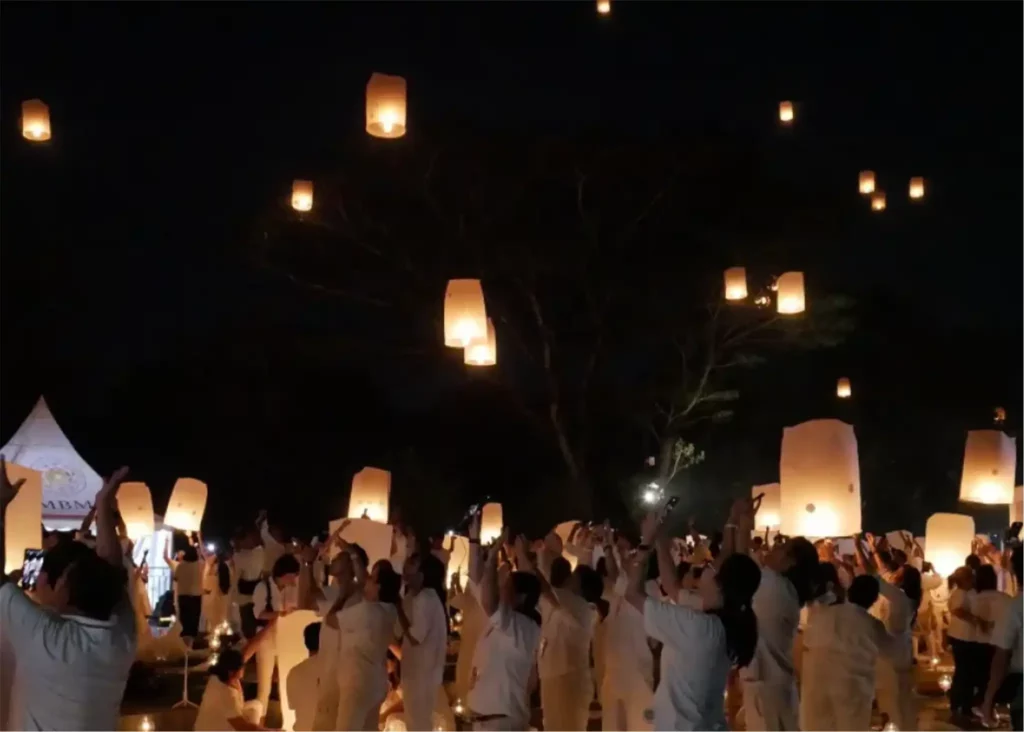
Buddhists are a small minority in Indonesia, which makes the scale of the Vesak celebration here surprising to most first-time visitors.
It begins before dawn, with the drawing of holy water from Umbul Jumprit spring and the lighting of the eternal dharma fire from Mrapen — two rituals that have been part of this ceremony for decades. Both are carried overland to Borobudur Temple in Central Java, where the main ceremony takes place.
The moment most people come for happens after dark, thousands of paper lanterns released into the night sky above the temple courtyard. It’s quiet, unhurried, and genuinely difficult to photograph in a way that does it justice.
Thailand: The City Goes Still for Visakha Bucha
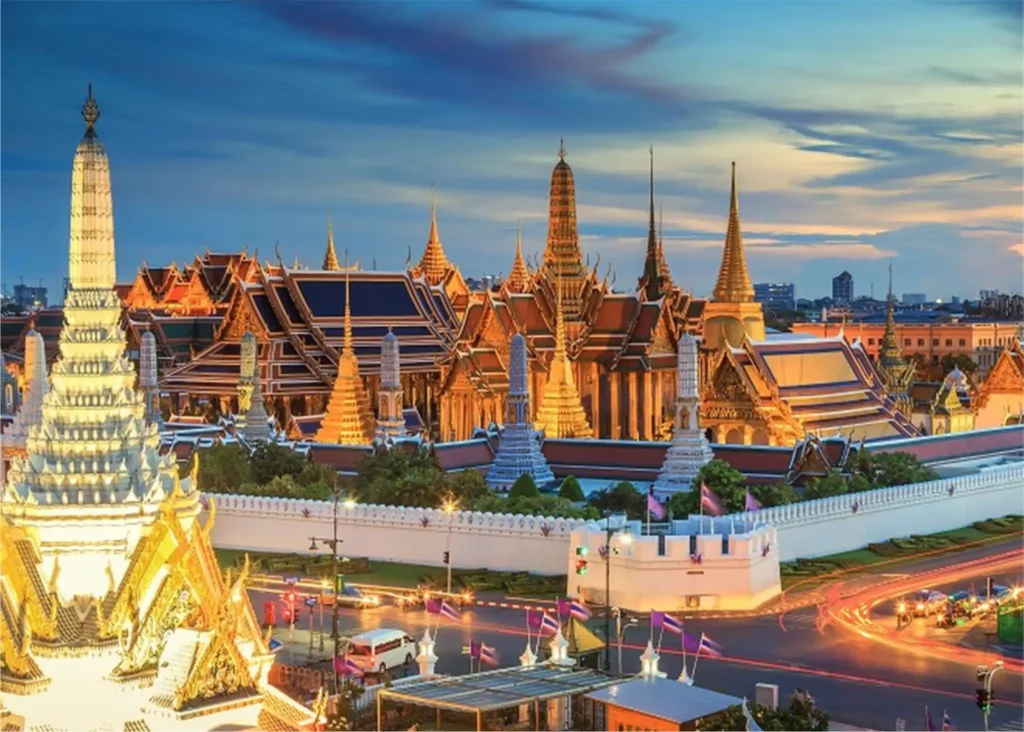
Thailand’s Vesak — officially called Visakha Bucha — is a national holiday, and the country treats it like one.
Alcohol sales are prohibited for the day. The streets around major temples fill early with residents lining up to offer food to monks at first light. By evening, the mood shifts, devotees gather to walk three clockwise circles around the temple stupa, each person carrying lotus flowers, incense, and a lit candle.
It’s one of the quieter national holidays you’ll encounter in Southeast Asia, deliberately so.
Japan: Cherry Blossoms and Sweet Tea
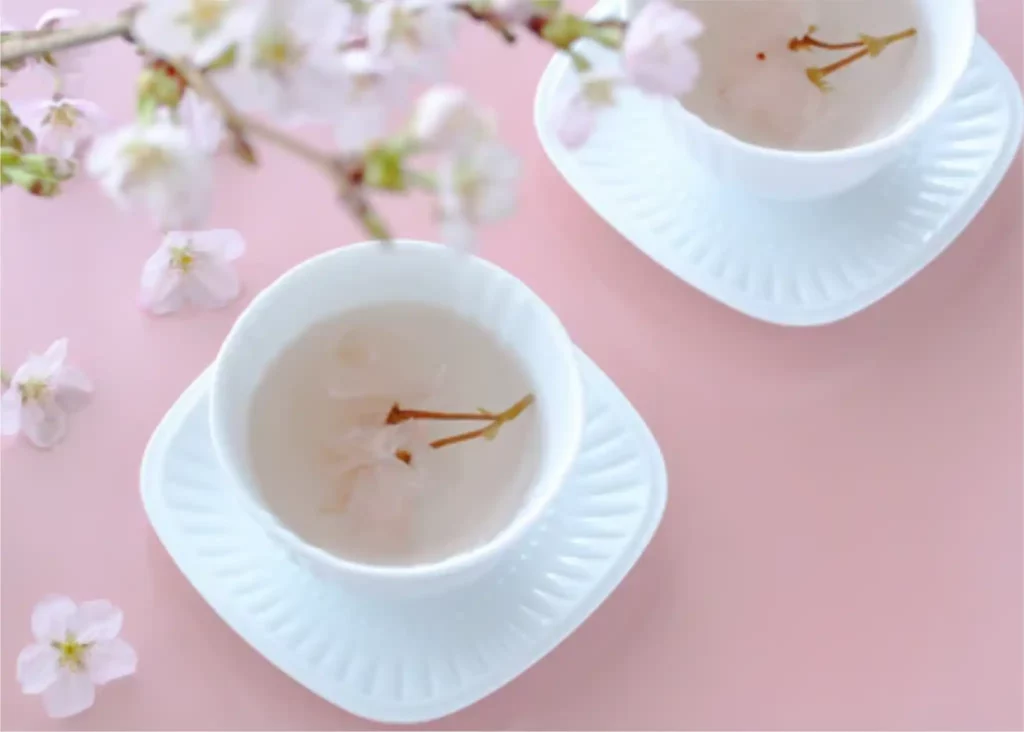
Japan celebrates the Buddha’s birthday on April 8th rather than following the lunar calendar, which means Hanamatsuri — the Flower Festival — often coincides with late cherry blossom season.
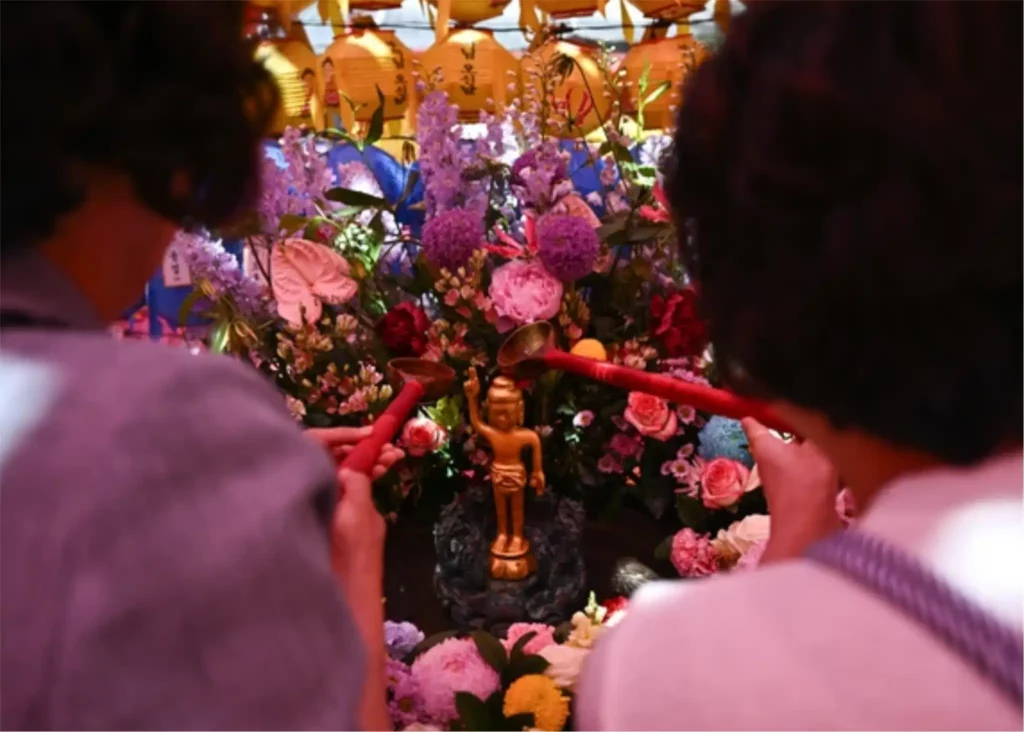
Temples set up small altars covered in fresh flowers, meant to represent the Lumbini Garden where the Buddha was born. Visitors then ladle ama-cha — a lightly sweet tea brewed from hydrangea leaves — over a small statue of the infant Buddha. The gesture comes from a legend: that when the Buddha entered the world, the heavens opened and rain fell to bathe him.
It’s an understated celebration by regional standards, but one with real elegance to it.
South Korea: Seoul Under Lantern Light
The Yeon Deung Hoe, or Lotus Lantern Festival, has been running for over a thousand years and was recognized by UNESCO as Intangible Cultural Heritage in 2020.
The main event is a parade through central Seoul — hanji paper lanterns shaped into dragons, white elephants, and phoenixes moving through streets that are otherwise ordinary on any other night of the year. What makes it distinctive is who shows up: the festival draws participants across religions and generations, and has become less a strictly Buddhist event than a citywide celebration that happens to have Buddhist roots.
China: Fódàn and the Practice of Letting Go
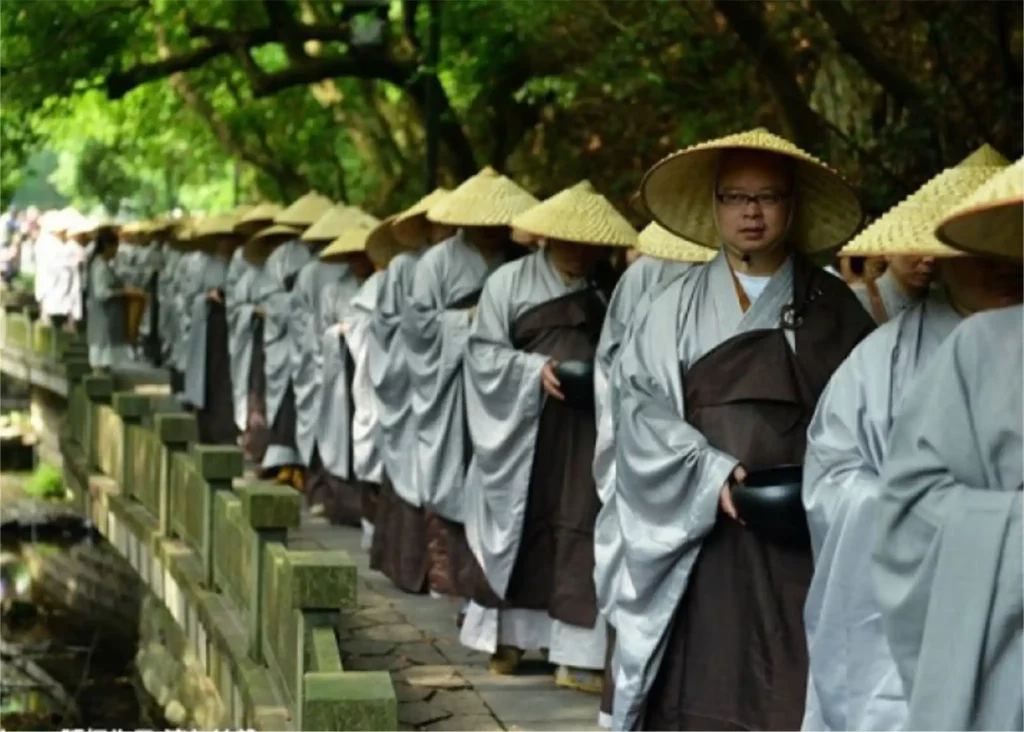
In China, Vesak falls on the 8th day of the 4th lunar month and is observed as Fódàn. The emphasis here leans more inward than ceremonial.
Temples perform the yufo ritual — bathing a Buddha statue in water infused with fragrant spices and flower petals, mirroring the Japanese tradition.
Outside the temples, the day is marked by vegetarian meals, charitable giving, and fangsheng: the release of captive animals back into the wild. It’s a quiet act, but one that carries real weight in Buddhist practice — the idea that compassion extends beyond the people immediately in front of you.
Sri Lanka: Thorana — Architecture Built to Be Temporary
https://berita.bhagavant.com/2021/05/25/sri-lanka-batalkan-festival-vesak-nasional-2021.html
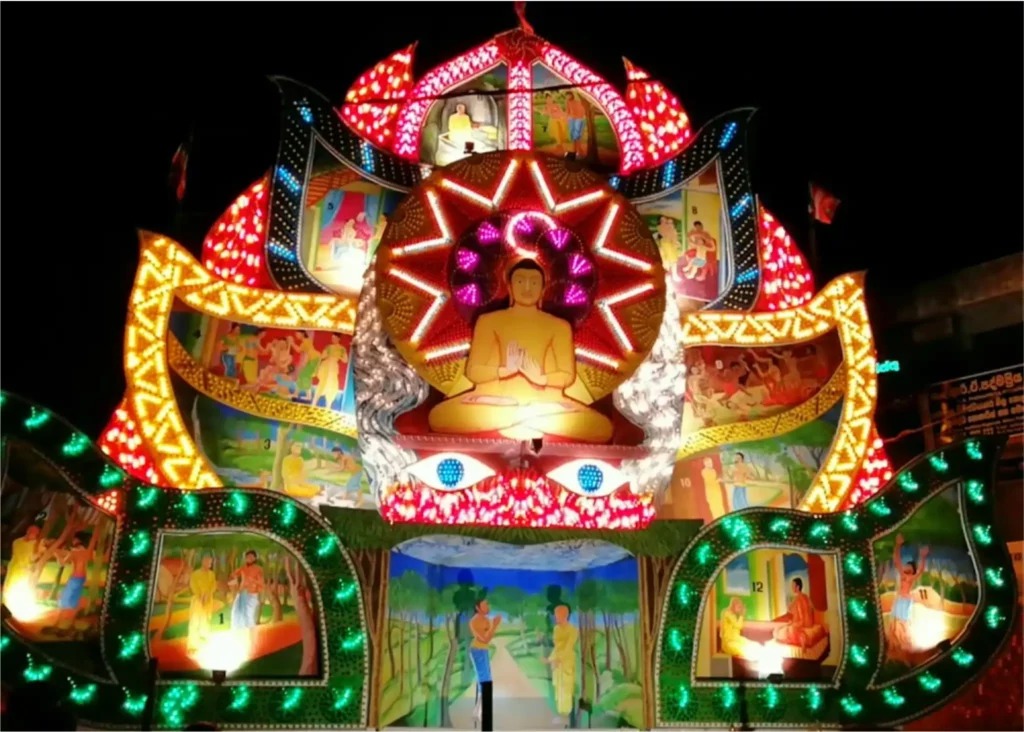
Sri Lanka’s Vesak is unlike anything else on this list, largely because of one tradition: the thorana.
These are giant bamboo arch structures — some reaching several stories high — constructed specifically for Vesak and dismantled after. Each one is covered in hand-painted panels illustrating stories from the Buddha’s past lives, lit from behind by thousands of colored lights. The craftsmanship involved is significant, and the fact that it’s built to last only days is part of the point.
Alongside the thorana, community groups set up dansala along the streets — open stalls offering free food and drinks to anyone passing through. No charge, no obligation. Just people feeding other people during a holy week.
Why These Differences Matter
The same occasion, filtered through centuries of local tradition, produces six genuinely different experiences. None of them is more authentic than the others — they’ve each just had more time to become themselves.
If you’re considering witnessing any of these firsthand, it’s worth knowing that the most memorable moments rarely happen at the main event. They happen in the conversation with the person next to you in the crowd, the explanation offered by a local when you look confused, the story behind something you almost walked past.
That’s where English tends to matter most — not for the tourist information, but for everything around it. If building that kind of confidence is something you’re working on, IELC is worth looking into.
Do you want to speak English with confidence?
Most people lack confidence when they speak English. They are afraid to make mistakes and are embarrassed to speak in front of others.
This is because they have been taught English the wrong way!
Most English courses waste your time and money on useless exercises that don’t bring results. Even worse, they teach you bad habits that are very difficult to unlearn.
As a result, you become confused and lack confidence. This is wrong!
At IELC, we teach English the right way
Our goal is to get you speaking in English with fluency and confidence as fast as possible. We want to give you the skills you need to fulfil your potential!
Our experienced teachers will guide you along every step of the learning process to ensure that you are not wasting your time, money, and energy on useless language exercises & wrong methods.
Our courses
With our modern campus and technology, we are equipped to provide the best possible courses for children, teens, and adults, including:
Online and on campus IELTS courses
Online and on campus TOEFL PBT courses
Online and on campus TOEFL iBT courses
We offer our classes in group classes or private classes.
No matter what your goals are, our team will help you achieve these goals by providing you with Indonesia’s best English courses!
Talk to our team today to get your FREE consultation and take your first step towards success.
Sincerely,

IELC Academic Director
Read More Articles
How to Track Your Child’s English Progress at Home
Tracking a child’s language progress at home is confusing. Last week they were singing along to their favorite cartoon. This week, asked a simple “how are you?” — nothing. It’s…

6 Strategies for Writing Emails that People Actually Read
Most mornings start the same way — an inbox with more unread messages than anyone wants to count, and a trigger finger ready to delete. Senders rarely know their email…
8 Tips to Make Your Lessons ADHD-Friendly
Real strategies for teachers who want every student — yes, every single one — to thrive. Every classroom has that one puzzle that’s harder to solve — and ADHD is…
TOEFL iBT vs. TOEFL ITP (PBT)
What’s the Difference and Which One Do You Need? So you’ve decided to take the TOEFL — great first step! But then you start researching and suddenly there are two…
12 Business Jargons You Nod Along To But Never Quite Understood
There’s a particular skill that nobody puts on their CV but almost everyone in the working world has quietly mastered: the art of nodding confidently at words you don’t fully…
How to Calculate Your IELTS Score
If IELTS feels a little mysterious, you are not alone. Most test takers spend weeks memorizing vocabulary, drilling reading passages, and practicing speaking answers, but still get confused when it…