



Unlocking Modal Verbs in Hypothetical and Conditional Statements: A Beginner’s Guide
Ever found yourself tangled up in English sentences that start with “If I were you…” or “I would have done it…”? You’re not alone. These are conditional statements, and the secret sauce that makes them work smoothly is modal verbs. This article is your ultimate beginner-friendly guide to understanding how modal verbs play a crucial role in hypothetical and conditional sentences. By the end, you’ll feel confident using them to express possibilities, regrets, advice, and more. This deep dive is perfect for English learners who want to sound natural and accurate when speaking about “what could have been” or “what might happen.”
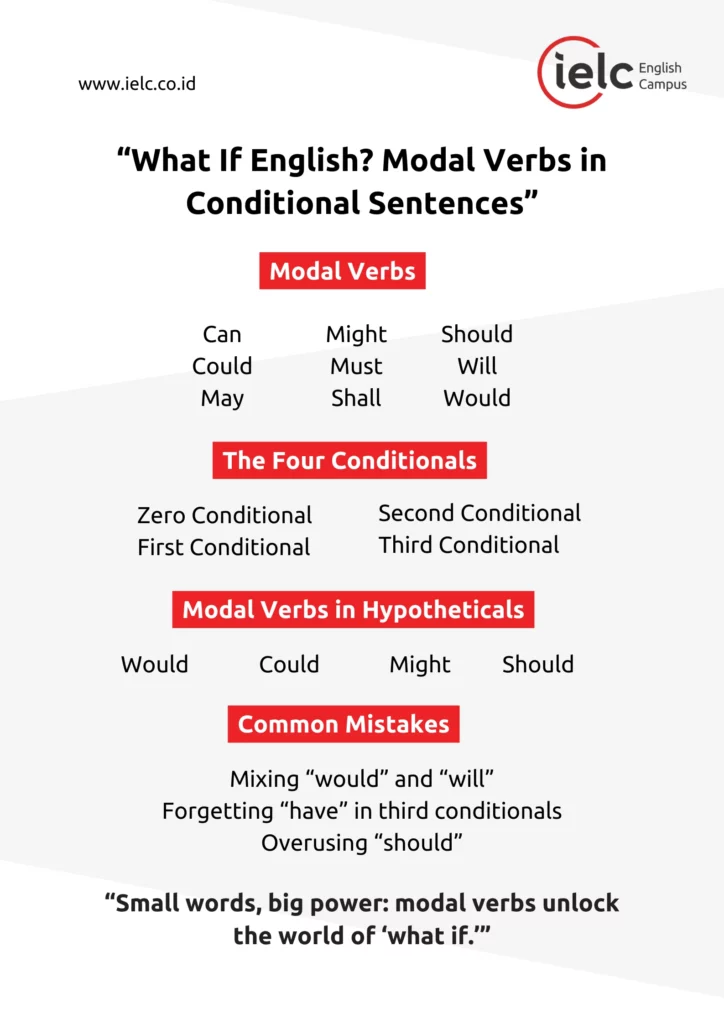
What Are Modal Verbs, Anyway?
Modal verbs are those small but mighty words—like can, could, may, might, must, shall, should, will, would—that change the mood of a sentence. They don’t stand alone; instead, they work alongside another verb to add meaning.
For example:
- I can swim. (ability)
- You should eat breakfast. (advice)
- We might be late. (possibility)
Now, when we step into the world of hypothetical and conditional statements, modal verbs become even more powerful.
What Are Conditional Statements?
\Conditional statements are those “if-then” sentences that describe possible outcomes, imagined situations, or consequences. Think of them as “cause and effect” with a twist.
Here are the main types you’ll encounter:
- Zero Conditional – Facts and truths
( If you heat water, it boils.)
- First Conditional – Real possibilities in the future
(If it rains, I will bring an umbrella.)
- Second Conditional – Unreal or imaginary situations
( If I won the lottery, I would buy a castle.)
- Third Conditional – Regrets or things that didn’t happen
(If I had studied harder, I might have passed the test.)
Notice how modal verbs show up in the second and third conditionals? That’s where they shine brightest.
Modal Verbs in Hypothetical Situations
Let’s break it down:
1. Using “Would” for Imagined Outcomes
When you want to talk about what you’d do in an unreal or imaginary situation, “would” is your best friend.
- If I were taller, I would play basketball.
- She would travel the world if she had enough money.
“Would” makes it clear that this is not reality—it’s just an imagined possibility.
2. Using “Could” for Possibility or Ability
“Could” expresses what might be possible or what someone would be able to do in a hypothetical scenario.
- If I had more free time, I could learn another language.
- He could help us if he weren’t so busy.
It softens the statement and shows potential without certainty.
3. Using “Might” for Uncertain Possibilities
“Might” is perfect when you want to talk about something less certain.
- If we left earlier, we might catch the train.
- They might like the idea if you explained it better.
“Might” keeps things open-ended, hinting at a chance but not a guarantee.
4. Using “Should” for Advice in Imaginary Contexts
“Should” comes in handy when giving advice based on an unreal situation.
- If I were you, I should apologize.
- He should take the opportunity if it came his way.
Here, “should” brings in a tone of recommendation, even when the situation isn’t real.
Modal Verbs in Conditional Statements
- Second Conditional: Dreaming and Imagining
This is where you explore “what if” scenarios in the present or future that are not real.
- If I had wings, I could fly.
- If you studied more, you would pass the exam.
Notice how “would,” “could,” and “might” give different shades of meaning:
- Would = definite imagined outcome
- Could = ability in the situation
- Might = uncertain possibility
- Third Conditional: Regret and Reflection
This is all about the past—things that didn’t happen, but you’re imagining if they had.
- If she had studied harder, she would have passed.
- If they had left earlier, they might have avoided traffic.
- If I had saved money, I could have traveled more.
Third conditionals are the grammar of “if only” and “what could have been.”

Common Mistakes Learners Make
1. Mixing up “Would” and “Will”
Wrong: If I win the lottery, I would buy a car.
Right: If I win the lottery, I will buy a car.
Why? Because winning is still possible—it’s not an imaginary scenario.
2. Forgetting “Have” in Third Conditionals
Wrong: If I had studied, I would pass.
Right: If I had studied, I would have passed.
The “have” is essential in third conditionals.
3. Overusing “Should”
Sometimes learners use “should” in places where “would” or “might” makes more sense. Keep in mind:
“Should” = advice
“Would” = definite outcome
“Might/Could” = possibility
Mastering modal verbs in conditional statements isn’t just about passing grammar tests—it’s about expressing yourself more naturally. Imagine telling stories, sharing regrets, or giving advice with confidence. It makes conversations richer and more engaging.
Modal verbs may look tiny, but they’re powerhouses when it comes to expressing imagination, possibility, regret, or advice in English. Once you get the hang of them, you’ll notice your English sounding more natural and expressive, especially in those “what if” moments.
Want to practice modal verbs and conditionals with real conversations, not just rules? At IELC, we make grammar fun, practical, and easy to use. With expert teachers, interactive lessons, and tailored practice exercises, you’ll master modal verbs in no time. Whether you’re aiming to ace an exam or just improve your fluency, IELC has the right course for you.
—
At IELC, we teach English the right way
Our goal is to get you speaking in English with fluency and confidence as fast as possible. We want to give you the skills you need to fulfill your potential!
Our experienced teachers will guide you along every step of the learning process to ensure that you are not wasting your time, money, and energy on useless language exercises & wrong methods.
Our courses
With our modern campus and technology, we are equipped to provide the best possible courses for children, teens, and adults, including:
Online and on campus IELTS courses
Online and on campus TOEFL PBT courses
Online and on campus TOEFL iBT courses
We offer our classes in group classes or private classes.
No matter what your goals are, our team will help you achieve these goals by providing you with Indonesia’s best English courses!
Talk to our team today to get your FREE consultation and take your first step towards success.
Sincerely,
Anthony McCormick,
IELC Managing Director
Read More Articles

How to Track Your Child’s English Progress at Home
Tracking a child’s language progress at home is confusing. Last week they were singing along to their favorite cartoon. This week, asked a simple “how are you?” — nothing. It’s…

6 Strategies for Writing Emails that People Actually Read
Most mornings start the same way — an inbox with more unread messages than anyone wants to count, and a trigger finger ready to delete. Senders rarely know their email…

8 Tips to Make Your Lessons ADHD-Friendly
Real strategies for teachers who want every student — yes, every single one — to thrive. Every classroom has that one puzzle that’s harder to solve — and ADHD is…

TOEFL iBT vs. TOEFL ITP (PBT)
What’s the Difference and Which One Do You Need? So you’ve decided to take the TOEFL — great first step! But then you start researching and suddenly there are two…

12 Business Jargons You Nod Along To But Never Quite Understood
There’s a particular skill that nobody puts on their CV but almost everyone in the working world has quietly mastered: the art of nodding confidently at words you don’t fully…

How to Calculate Your IELTS Score
If IELTS feels a little mysterious, you are not alone. Most test takers spend weeks memorizing vocabulary, drilling reading passages, and practicing speaking answers, but still get confused when it…