


Common ESL Teacher Interview Questions and Sample Answers (With Fun Tips to Stand Out!)
You’ve polished your resume, updated your teaching portfolio, and maybe even practiced a classroom demo in front of your cat. But then comes the most important part: the interview. It’s where schools decide if you’re the right person to inspire and guide their English learners.
If your heart is pounding already, relax. You’re not alone—ESL teacher interviews can feel intimidating, but they’re also a golden opportunity to show your personality, teaching philosophy, and passion. In this article, we’ll break down the most common ESL teacher interview questions, give you sample answers that don’t sound robotic, and throw in some fun confidence-boosting tips along the way.
By the end, you’ll be ready to walk into your interview with a smile (and maybe even crack a small joke to ease the tension).
Why ESL Teacher Interviews Are Unique
Unlike a standard job interview, ESL teaching interviews often test more than just your qualifications. Schools want to see:
- How you communicate clearly.
- Whether you can adapt to different learning styles.
- If you have patience and creativity.
And—this one’s key—how you handle students with little to no English ability.
That means your answers need to be clear, structured, and peppered with real-life teaching examples. Bonus points if you can show enthusiasm without sounding like you swallowed a motivational poster.
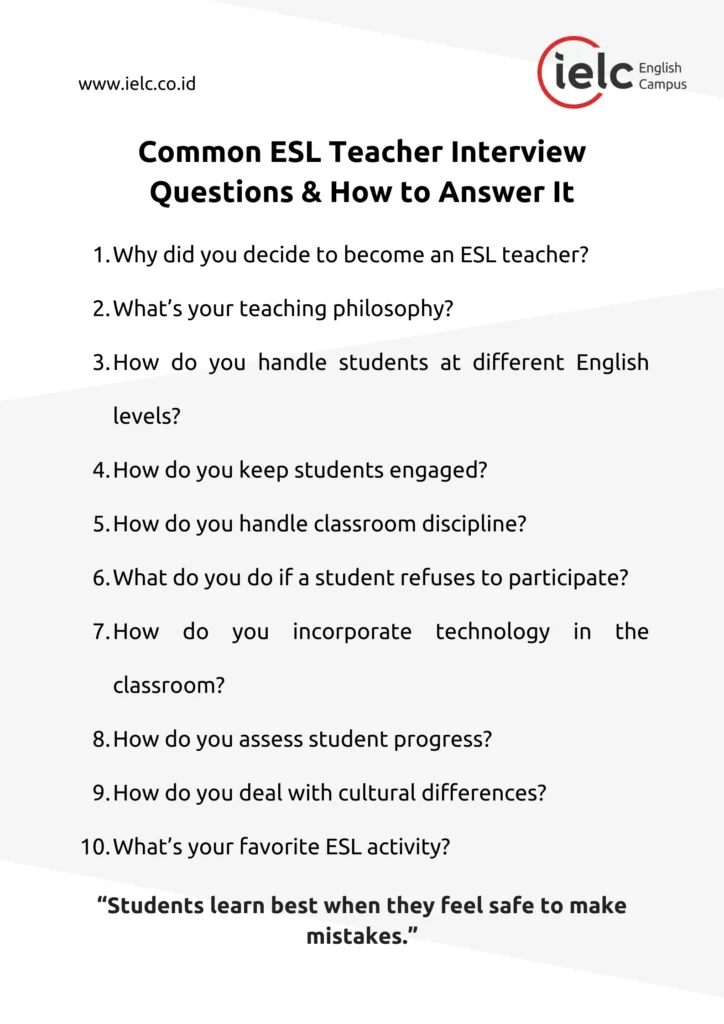
Below are 12 of the most common ESL teacher interview questions, along with sample answers you can adapt to your own style.
1. “Why did you decide to become an ESL teacher?”
Why they ask: They want to know if you’re in it for the right reasons (hint: it shouldn’t just be for travel perks or flexible hours).
Sample answer:
“I became an ESL teacher because I love the way language opens doors. When I taught my first English conversation club, I saw how even small improvements gave students confidence to participate in new communities. That moment hooked me—I wanted to help more learners discover that feeling.”
Pro tip: Share a short personal story. Interviewers love a genuine spark.
2. “What’s your teaching philosophy?”
Why they ask: They’re checking if your style aligns with their school’s culture.
Sample answer:
“My teaching philosophy is that students learn best when they feel safe to make mistakes. I design lessons that are interactive, student-centered, and tied to real-life use. I want students to leave class not just with grammar knowledge but with confidence to speak outside the classroom.”
3. “How do you handle students at different English levels in the same class?”
Why they ask: Mixed-level classrooms are the norm, not the exception.
Sample answer:
“I use tiered activities—so advanced students get extension tasks while beginners practice core skills. Pair work also helps, since stronger students can mentor weaker ones. It creates collaboration instead of frustration.”
Fun note: Schools love hearing you have strategies for inclusivity.
4. “How do you keep students engaged?”
Why they ask: Because bored students = discipline problems.
Sample answer:
“I mix activities often—games, role plays, and real-life scenarios. For example, in one lesson I set up a ‘restaurant role play,’ where students ordered food and practiced politeness. They were laughing, speaking, and learning without realizing it.”
5. “How do you handle classroom discipline?”
Why they ask: They want to know you won’t lose control.
Sample answer:
“I believe prevention is key. I set clear expectations from the start and keep lessons engaging. If issues arise, I address them calmly and respectfully, focusing on the behavior, not the student. I’ve found this keeps the class atmosphere positive and respectful.”
6. “What do you do if a student refuses to participate?”
Why they ask: It tests your patience and adaptability.
Sample answer:
“I try to find out the reason—maybe the student feels shy or doesn’t understand. I might pair them with a supportive classmate, or give them a smaller role at first. Small successes usually build their confidence to participate more.”

7. “How do you incorporate technology in the classroom?”
Why they ask: Tech-savvy teachers are in high demand.
Sample answer:
“I use tools like Quizlet for vocabulary practice, Kahoot for quick reviews, and video clips to spark discussion. But I make sure technology supports the lesson, not the other way around. Students should leave with stronger communication skills, not just screen time.”
8. “How do you assess student progress?”
Why they ask: Schools need measurable results.
Sample answer:
“I use a mix of formal and informal assessments—quizzes, projects, and class participation. I also track speaking progress with short interviews every few weeks. This gives me a clear picture of growth and areas to target.”
9. “How do you deal with cultural differences in the classroom?”
Why they ask: ESL classrooms are often culturally diverse.
Sample answer:
“I make cultural awareness part of the learning process. For example, we might compare greetings in English to those in the students’ native languages. This not only teaches English but also builds mutual respect and curiosity.”
10. “What’s your favorite ESL activity?”
Why they ask: They’re curious about your creativity.
Sample answer:
“My favorite is ‘Find Someone Who.’ It gets students moving, asking each other questions, and practicing conversation naturally. It works with all levels and never fails to bring energy to the room.”
11. “Where do you see yourself in five years?”
Why they ask: They want to know if you’re serious about teaching.
Sample answer:
“I see myself continuing to grow as an ESL teacher, possibly taking on a senior teaching or curriculum design role. I want to keep learning new methods and helping shape programs that empower students long-term.”
12. “Do you have any questions for us?”
Why they ask: They want to see if you’re genuinely interested.
Sample answer:
“Yes! Could you tell me more about the school’s support for teacher training and professional development? Also, what does a successful teacher look like at this school?”
Pro tip: Never say, “No, I don’t have any questions.” That’s like going on a date and not asking anything about the other person.
Quick Tips to Shine in Your ESL Teacher Interview
- Practice storytelling: Interviewers remember stories, not bullet points.
- Smile (seriously): It shows warmth, which is huge in teaching.
- Have a mini-lesson ready: Some interviews ask for a quick demo.
- Be flexible: Show you can adapt—because classrooms rarely go as planned.
Common Mistakes ESL Teachers Make in Interviews
1. Overloading answers with jargon. Keep it simple—show how you’d explain concepts clearly to students.
2. Forgetting cultural sensitivity. ESL classrooms are diverse; don’t ignore that.
3. Sounding too scripted. Practice is good, but you should sound like yourself, not a textbook.
4. Not asking questions back. Remember, you’re also checking if the school fits you.
Wrapping It Up: Confidence Is Your Best Tool
ESL teacher interviews aren’t about being perfect—they’re about showing you’re adaptable, empathetic, and genuinely excited about helping students learn. With these common questions and sample answers, you’ll be able to walk into your interview with confidence, charm, and practical strategies up your sleeve.
And remember: sometimes the best answer isn’t the most polished one, but the one that shows your humanity.
Want to Take Your ESL Teaching Skills Even Further?
If you’d like to sharpen your English teaching knowledge, boost your communication skills, or simply feel more confident, IELC (Indonesia’s #1 English course) is the perfect place to start. With engaging programs for teachers and learners alike, IELC helps you level up your English skills in a way that’s practical, fun, and empowering.
Because at the end of the day, the best teachers are lifelong learners too.
Do you want to speak English with confidence?
Most people lack confidence when they speak English. They are afraid to make mistakes and are embarrassed to speak in front of others.
This is because they have been taught English the wrong way!
Most English courses waste your time and money on useless exercises that don’t bring results. Even worse, they teach you bad habits that are very difficult to unlearn.
As a result, you become confused and lack confidence. This is wrong!
At IELC, we teach English the right way
Our goal is to get you speaking in English with fluency and confidence as fast as possible. We want to give you the skills you need to fulfill your potential!
Our experienced teachers will guide you along every step of the learning process to ensure that you are not wasting your time, money, and energy on useless language exercises & wrong methods.
Our courses
With our modern campus and technology, we are equipped to provide the best possible courses for children, teens, and adults, including:
- Online courses for kids
- Online courses for teens
- Online courses for adults
- On campus courses for kids
- On campus courses for teens
- On campus courses for adults
- Online and on campus IELTS courses
- Online and on campus TOEFL PBT courses
- Online and on campus TOEFL iBT courses
We offer our classes in group classes or private classes.
No matter what your goals are, our team will help you achieve these goals by providing you with Indonesia’s best English courses!
Talk to our team today to get your FREE consultation and take your first step towards success.
Sincerely,
Anthony McCormick,
IELC Managing Director
Read More Articles

8 Tips to Make Your Lessons ADHD-Friendly
Real strategies for teachers who want every student — yes, every single one — to thrive. Every classroom has that one puzzle that’s harder to solve — and ADHD is…

TOEFL iBT vs. TOEFL ITP (PBT)
What’s the Difference and Which One Do You Need? So you’ve decided to take the TOEFL — great first step! But then you start researching and suddenly there are two…

12 Business Jargons You Nod Along To But Never Quite Understood
There’s a particular skill that nobody puts on their CV but almost everyone in the working world has quietly mastered: the art of nodding confidently at words you don’t fully…

How to Calculate Your IELTS Score
If IELTS feels a little mysterious, you are not alone. Most test takers spend weeks memorizing vocabulary, drilling reading passages, and practicing speaking answers, but still get confused when it…

5 Proven Ways to Engage Adult Learners in English Class
Teaching adults is never just about teaching English. They walk into class carrying different energies — some are expressive and eager to talk, others are quieter, more deliberate with their…

How to Restart Your English Learning After a Long Holiday
You’re not imagining it—coming back to English after a long holiday really does feel harder than it should. Words you used to know suddenly disappear, listening feels slower, and even…